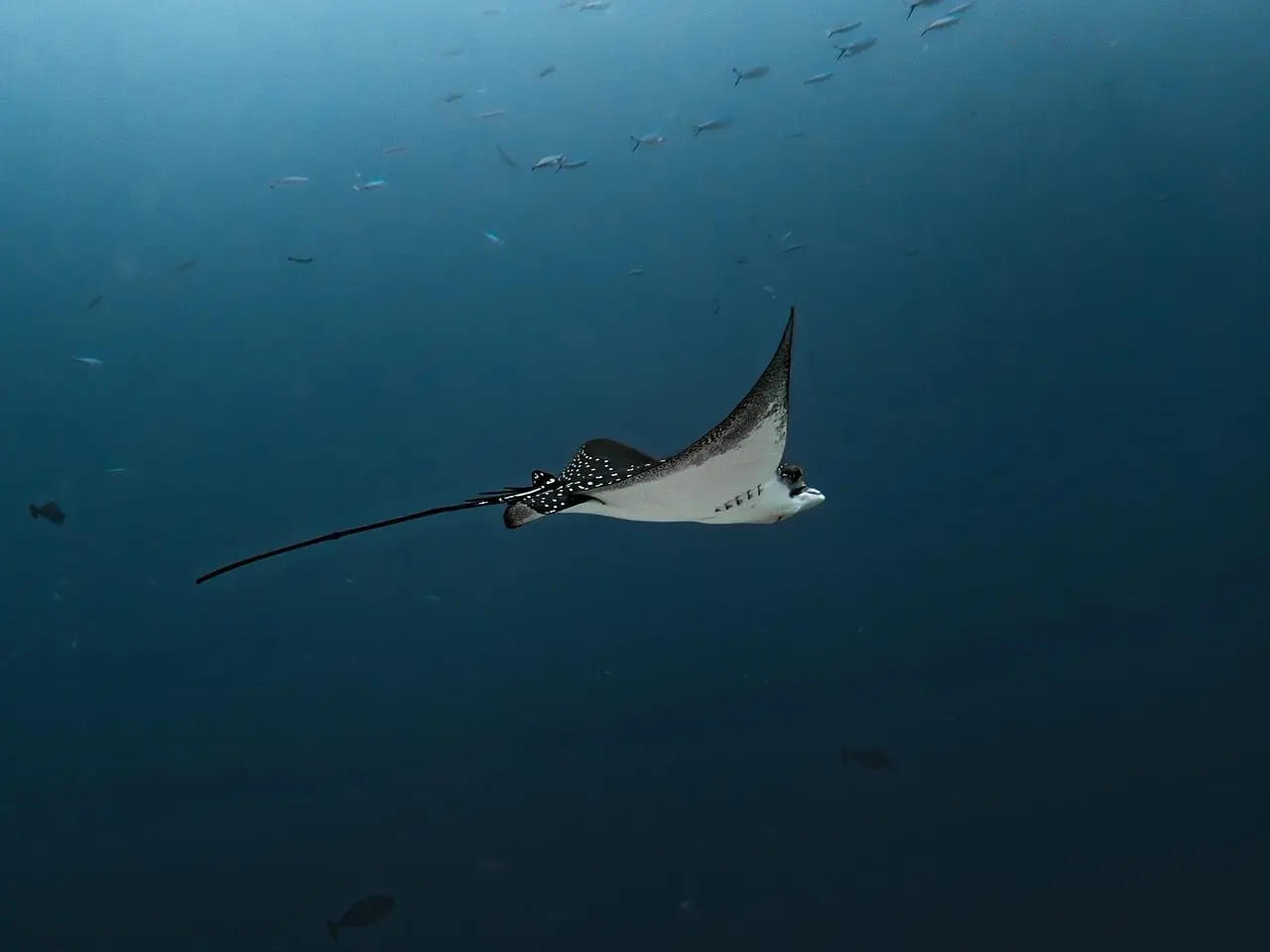
For stingrays Solomon Islands diving splits into two shapes: flat, oval stingrays on sand and diamond-shaped eagle rays in open water. Eagle rays are the species named at Solomon dive sites, while stingrays suit shallow sandy areas.
Rays are one thread in solomon islands marine life, and the reef settings where they cruise are covered in solomon islands coral reefs.
How the rays are ordered
No ranking applies here, because each ray suits a different kind of dive. The list below runs from open water down to the sand, and each entry says what to look for, who it suits and where it falls short. Three criteria decide the order.
- Where it is met: some rays cruise in mid-water or along drop-offs, while others lie on the seabed. That decides which dive, and which part of it, gives the best chance.
- How easy it is to identify: disc shape, head and tail are the quickest cues. Colour and spotting add detail once the ray is close.
- Sting concern: the tail spine matters most for rays that lie still, because a motionless ray is the one a diver might drift towards.
- Spotted eagle ray: best for drift dives and mid-water scanning.
- Blue-spotted stingray: best for slow, shallow dives over sand and reef flats.
- Manta ray: included as a point of comparison, with encounters left to their own guide.
Rays worth watching for
Spotted eagle ray
The spotted eagle ray is the ray most often named for Solomon Islands reef and wreck sites. Dive Worldwide lists eagle ray and manta ray among the species that make the islands ideal for viewing. World of Diving describes Grand Central Station, a drift dive in the Gizo area where oceanic currents meet, with sharks, trevally, barracuda, mantas and eagle rays, at depths of 16-131 ft.
Eagle rays are pelagic animals that use open ocean and coral reefs. They are often seen near the surface or in mid-water, with a depth range to 60 m, according to the BlueRides eagle ray and stingray comparison. The spotted eagle ray grows up to 2.5 m across the disc, so it is a large animal even though it is not the largest ray in these waters.
It suits divers who enjoy drift dives and who scan the blue as well as the reef. Its limit is predictability. A mid-water ray passes through rather than staying at a known spot, so treat a sighting as a bonus on a current dive rather than the reason to choose a site.
Blue-spotted stingray
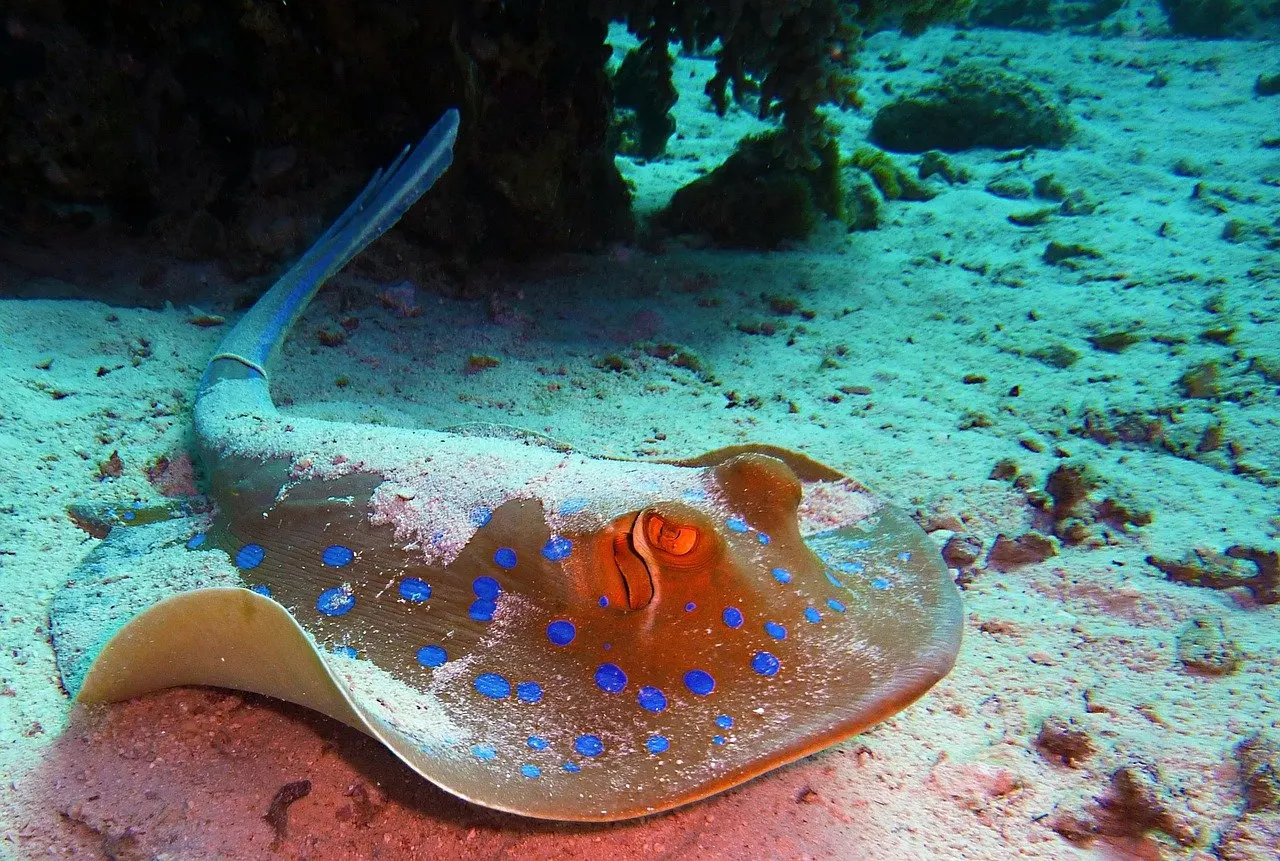
The blue-spotted stingray is the small, bottom-dwelling choice. The BlueRides comparison describes the Blue-spotted Ribbontail Ray as relatively small beside larger stingray species, and stingrays in general typically measure 0.5 to 1.5 m across the disc. That puts the blue-spotted stingray at the manageable end of the range, easy to take in at a glance on a calm dive.
Three cues identify a stingray, and the blue spots confirm the species:
- Disc shape: a much flatter, more rounded or oval disc, with pectoral fins blending seamlessly into the body. There is no separate head sticking out of the outline.
- Tail: generally thicker and shorter than an eagle ray’s whip-like tail, and usually carrying one or more venomous spines.
- Spotting: bright blue spots across a brown disc, as visible in the photo below. Even when the ray is partly covered, the spotted pattern separates it from other sand-dwellers.
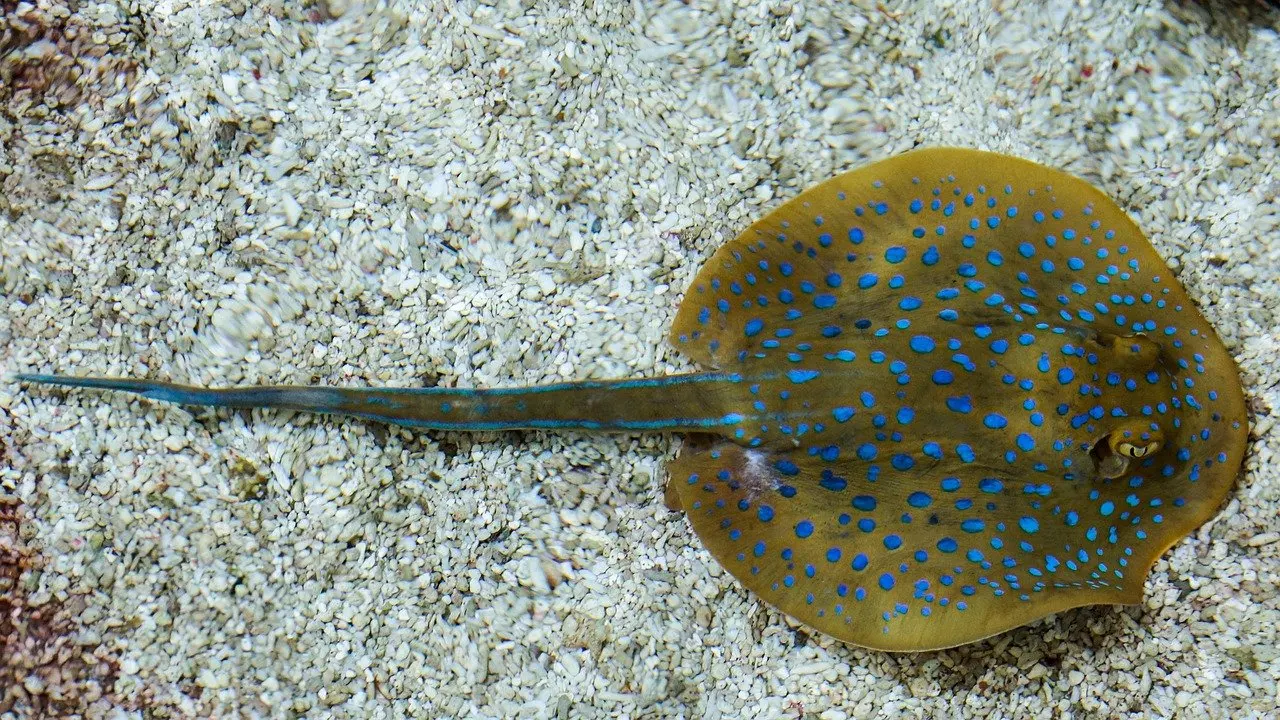
This ray suits newer divers and photographers who prefer slow, shallow dives. Its limit is visibility: a ray that buries itself is easy to miss, and a diver who swims over the sand without looking closely will pass it by.
Manta ray as a reference point
The manta ray appears beside eagle rays in the Solomon Islands site lists, which is why the two are often confused at a distance. Manta behaviour, sites and encounter etiquette are covered separately in the guide to manta rays solomon islands. This page uses the manta only as the yardstick for telling an eagle ray apart.
Eagle ray versus manta ray
An eagle ray is separated from a manta by its head and tail. The BlueRides comparison describes eagle rays as having a defined, often elevated head that protrudes forward from a diamond-shaped disc. The tail is very long and whip-like, often several times the body length.
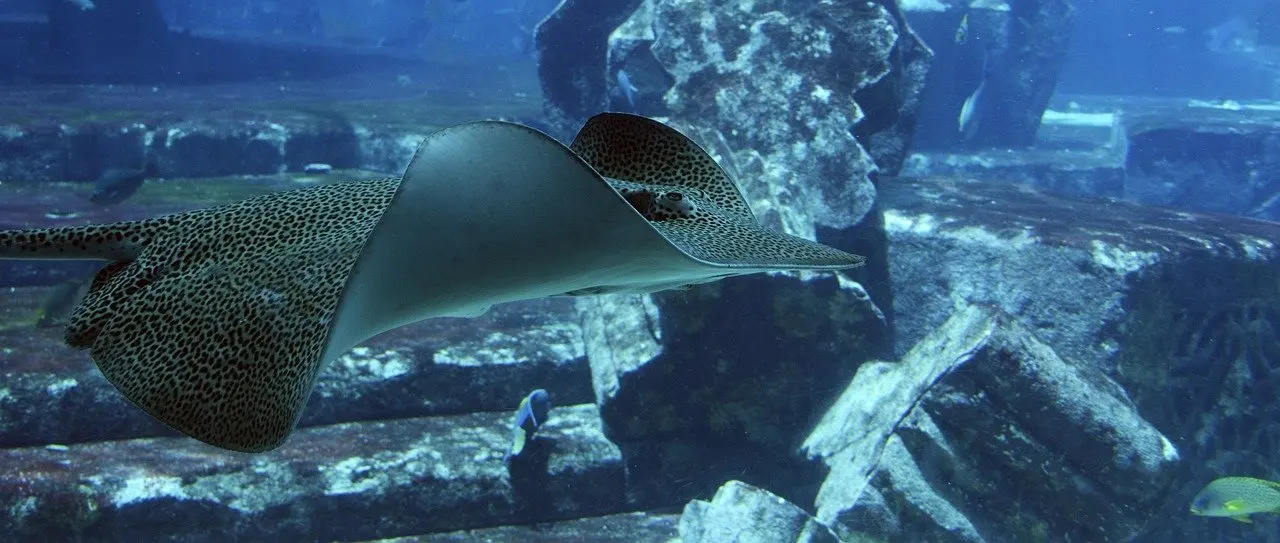
The manta in the photo below has broad, wing-like pectoral fins in a smooth sweep. The eagle ray’s forward-protruding head and extremely long tail give it a more angular outline from the side.
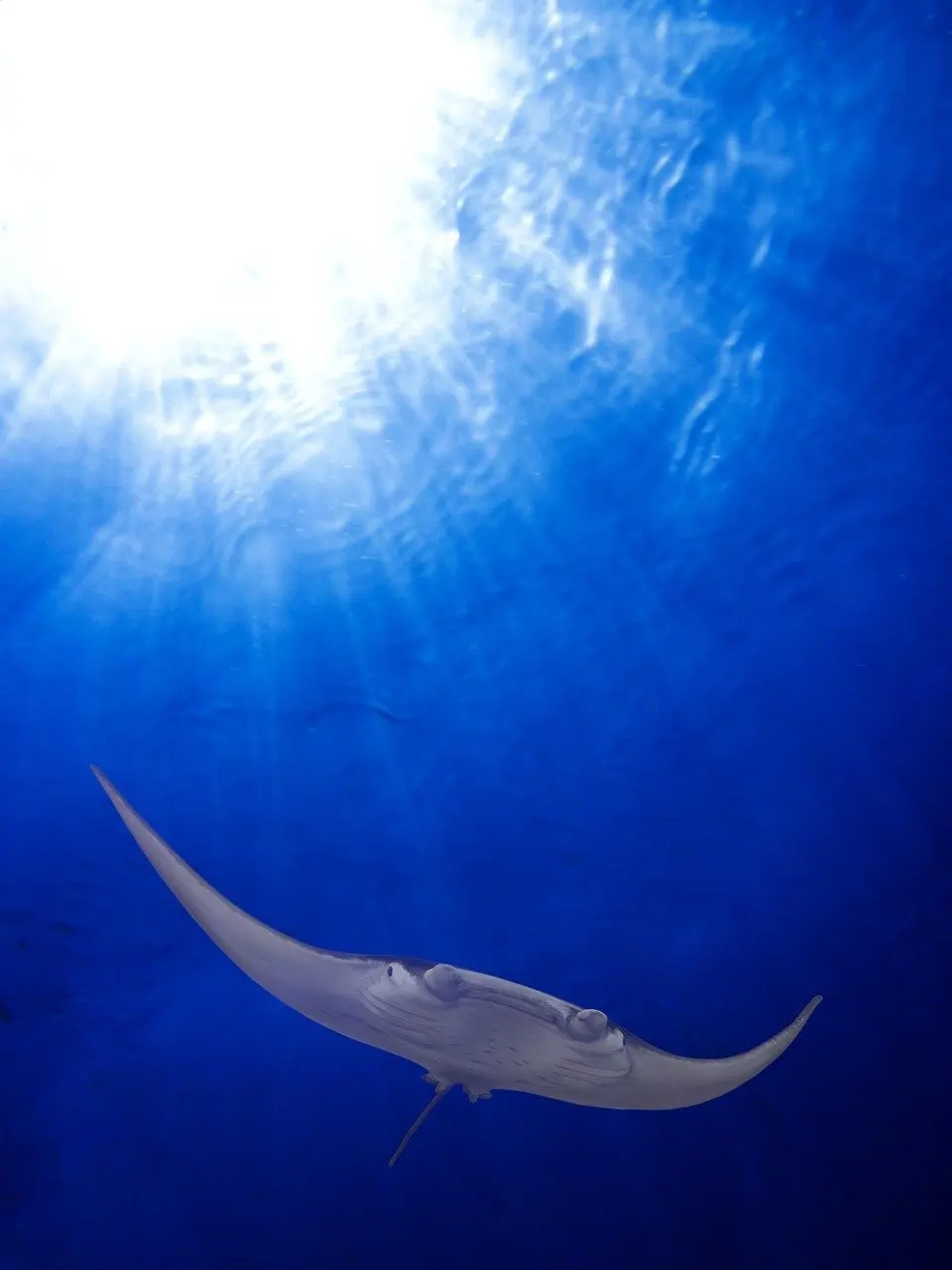
The practical cue for a diver is the outline. If the animal has a distinct head poking out of the disc and a long thin tail, treat it as an eagle ray. If the wings dominate the shape, it is more likely a manta, and the manta guide then applies.
Where rays rest and feed
Stingrays rest on the bottom, and eagle rays work the water above and along it. Stingray encounters are more common in shallower, sandy areas or on reef flats, and their habitat covers sandy bottoms, seagrass beds and coral reef flats, to a depth of 300 m, according to BlueRides. They often bury themselves in sand or mud with only their eyes and spiracles showing.
In practice, a sandy reef flat is the place to slow down. A diver who sees two eyes and a small gap on the sand should keep a respectful distance rather than assume the animal is a stone.
Eagle rays feed differently. They use pointed snouts to probe sandy bottoms for buried prey such as mollusks and crustaceans, and also take small fish. That makes sand patches beside a drop-off a plausible place to see one working near the bottom, although the animal remains mobile.
For regions, World of Diving places the dive areas of Gizo, Munda and Uepi in the New Georgia island group. Dive Worldwide names Gizo, Munda and Marovo Lagoon among the western province resort areas. Gizo and Munda appear in both lists, which makes the Western Province the sensible place to start looking for rays.
Stingray barbs and diver safety
Rays are not a serious hazard to divers who leave them alone. Both eagle rays and stingrays carry one or more venomous spines on the tail, but BlueRides reports that stings are rare and usually happen only when the ray feels threatened or is handled.
The stingray barb is the reason to keep the tail in mind rather than the disc. Because a stingray rests with its tail behind a flat body, the risk comes from approaching or touching a ray that cannot easily retreat. The sensible rules follow directly:
- Do not touch or handle: handling is named as a trigger for stings.
- Do not crowd a resting ray: a ray that feels threatened is the one that uses its spine, so give a sand-dweller room to leave.
- Look before kneeling: a partly buried ray shows only eyes and spiracles, so check the sand before settling on it for a photograph.
Eagle ray and stingray compared
| Feature | Spotted eagle ray | Stingrays, including blue-spotted | Planning use |
|---|---|---|---|
| Body outline | Diamond-shaped disc with a defined, often elevated head | Flatter, rounded or oval disc; fins blend into the body | Check the head first when identifying at a distance. |
| Tail | Very long and whip-like, often several times body length | Thicker and generally shorter | A trailing thin tail points to an eagle ray. |
| Disc width | Up to 2.5 m for the spotted eagle ray; eagle rays in general up to 3 m | Typically 0.5 to 1.5 m, with the blue-spotted ribbontail relatively small | Expect the stingray to be much the smaller animal. |
| Habitat | Pelagic; mid-water and reef drop-offs, to 60 m | Benthic; sandy bottoms, seagrass and reef flats, to 300 m, often partly buried | Scan the blue for eagle rays and the sand for stingrays. |
| Sting risk | One or more venomous tail spines | One or more venomous tail spines | Rare stings; avoid threatening or handling either. |
Measurements and shape descriptions in the table come from the BlueRides eagle ray versus stingray comparison.
Frequently asked questions
How big do eagle rays and stingrays get?
Eagle rays reach up to 3 m across the disc in general, and the spotted eagle ray up to 2.5 m. Stingrays typically measure 0.5 to 1.5 m, according to BlueRides.
Which Solomon Islands area suits a first search for eagle rays?
The Gizo area is a sound start, because Grand Central Station there is a drift dive described with eagle rays and mantas. Munda also appears in dive area lists for the Western Province.
What do eagle rays eat?
Eagle rays probe sandy bottoms with their pointed snouts for buried mollusks and crustaceans. They also eat small fish.
Can a diver tell a stingray from an eagle ray at a glance?
Yes. A flat, oval disc with no separate head and a short thick tail indicates a stingray, while a head protruding from a diamond-shaped disc with a long whip-like tail indicates an eagle ray.